Engineered to seal,
The last line of defense against leakage
+86-13566064802

Views: 0 Author: Site Editor Publish Time: 2026-10-12 Origin: Site
Chemical dosing pumps operate under stringent requirements where a single seal failure causes hazardous leaks, inaccurate dosing, and catastrophic system downtime. Standard elastomeric gaskets degrade rapidly when exposed to aggressive acids, alkalis, and solvents. While polytetrafluoroethylene offers near-universal chemical resistance, selecting the wrong grade or structural type leads to creep relaxation, loss of bolt load, and premature failure. This guide provides a technical framework for evaluating and selecting the correct PTFE Gaskets for Chemical Pumps. We balance chemical compatibility with mechanical stability, pressure ratings, and flange conditions to ensure reliable operation. You need seals that hold up under harsh conditions without constant retorquing. We will break down exactly how to match the right fluoropolymer structure to your specific pump hardware.
Chemical Universality vs. Mechanical Limits: While virgin PTFE resists nearly all industrial chemicals, its inherent "cold flow" (creep) requires structural mitigation in high-pressure dosing applications.
Material Selection is Application-Specific: Filled PTFE, expanded PTFE (ePTFE), and PTFE envelope gaskets offer distinct mechanical trade-offs designed to solve specific pressure, temperature, and flange-alignment challenges.
Flange Compatibility Dictates Gasket Type: The choice of PTFE gasket depends heavily on the flange material (e.g., metal vs. fragile FRP/plastic) and available compressive load.
Installation Protocols Determine Lifespan: Proper torque sequencing and retorquing strategies are mandatory to counteract PTFE’s natural relaxation tendencies and maintain a leak-free seal.
Table of Contents
PTFE gaskets provide chemical resistance and reliable sealing for chemical metering pumps. They help prevent leakage, maintain dosing accuracy, and reduce contamination risks in water treatment, pharmaceutical, and chemical processing applications. Proper gasket selection must also consider operating pressure, temperature, vibration, and flange compatibility.
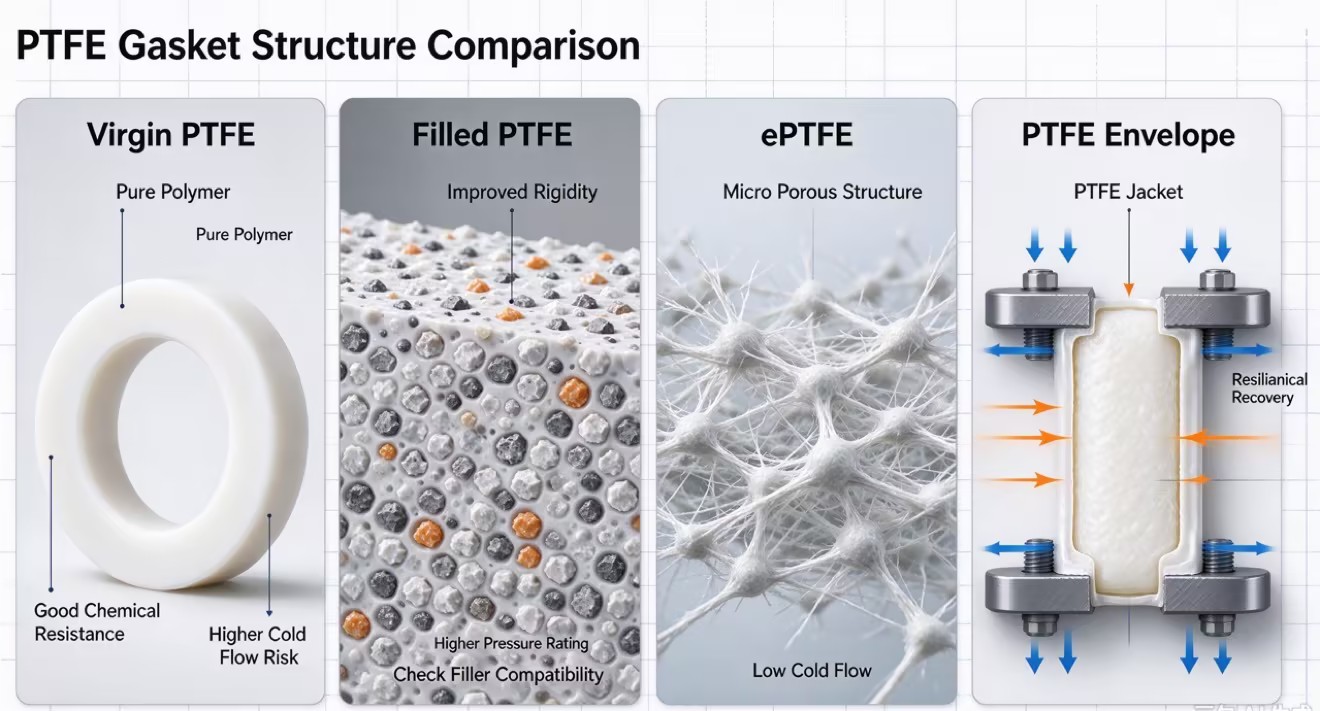
Cold flow (creep relaxation) is a common limitation of virgin PTFE. Under continuous compression and temperature changes, the material may deform, reducing bolt load and increasing leakage risks. Modified or expanded PTFE gaskets offer improved creep resistance, helping maintain sealing performance during long-term operation.
Virgin PTFE gaskets provide excellent chemical resistance and high material purity without added fillers. They are suitable for applications where chemical compatibility and contamination control are priorities.
PTFE resin products, such as those in Daikin's fluoropolymer range, illustrate the material's chemical and thermal resistance properties. However, virgin PTFE remains susceptible to cold flow, making gasket design and operating conditions important selection factors.
Filled PTFE gaskets incorporate reinforcing materials to improve compressive strength, creep resistance, and dimensional stability. Common fillers include glass fibers, carbon, graphite, and other specialized materials.
For example, Daikin's POLYFLON PTFE Compound-Series illustrates how different fillers modify PTFE properties for industrial sealing applications.
The appropriate formulation should be selected according to chemical compatibility, operating temperature, pressure, and flange conditions.
Expanded PTFE (ePTFE) gaskets feature a flexible, microporous structure that provides high compressibility and improved sealing performance. They conform well to uneven flange surfaces and generally require lower seating stress than rigid filled PTFE gaskets. This makes them suitable for FRP, PVC, glass-lined, and other flange materials with limited bolt-load capacity.
PTFE envelope gaskets combine a chemically resistant PTFE outer jacket with a compressible core, such as EPDM, FKM, or another suitable filler material. This construction provides chemical protection and mechanical flexibility, making them suitable for chemical dosing systems requiring reliable sealing under moderate pressure and temperature variations.al flexibility, particularly in large-diameter piping connected to dosing skids.
Chemical compatibility is essential when selecting PTFE gaskets for chemical dosing systems. Engineers should evaluate chemical type, concentration, mixed media, and cleaning agents to prevent seal degradation. Both the PTFE material and any fillers must be compatible with the operating environment to ensure reliable sealing.
Temperature and pressure conditions directly affect gasket performance and service life. High temperatures can increase deformation and creep, while repeated thermal cycling may reduce sealing stress. Selecting suitable virgin, filled, or expanded PTFE grades helps maintain sealing reliability under changing operating conditions.
Flange material and bolt load influence gasket selection. Metal flanges can generally accommodate higher bolt loads, while plastic, FRP, and glass-lined flanges may require more compressible gasket materials.
The ASTM F104 classification system for nonmetallic gasket materials provides a framework for describing relevant material properties and comparing gasket material specifications.
However, material classification alone does not establish suitability for a specific flange joint. Engineers must also consider chemical compatibility, sealing stress, and operating conditions.
Gasket Type | Cold Flow Resistance | Compressibility | Suitable Flange Applications |
|---|---|---|---|
Virgin PTFE | Low | Moderate | Smooth metal flanges |
Filled PTFE | High | Low | Rigid metal flanges |
Expanded PTFE (ePTFE) | High | Very High | FRP, plastic, glass-lined flanges |
PTFE Envelope | Depends on filler | Depends on filler | Chemical-service flanges requiring a compatible core |
Gasket manufacturing methods influence dimensional accuracy, edge quality, and installation performance. Sheet cutting, CNC machining, and waterjet cutting accommodate different flange geometries and precision requirements. Accurate gasket dimensions help prevent improper seating, flow restrictions, and premature sealing failure.
Gasket selection should consider total operating costs rather than purchase price alone. Although specialized filled or expanded PTFE gaskets may require higher initial investment, improved sealing reliability can reduce leakage, maintenance expenses, and production downtime. Choosing materials suited to the application provides better long-term value.
Mean Time Between Failures (MTBF) helps evaluate gasket reliability in chemical dosing systems. Selecting durable gasket materials and maintaining proper bolt load can reduce leakage and unplanned maintenance. Aligning gasket replacement intervals with scheduled pump servicing helps improve operational efficiency and extend equipment service life.
Audit your current chemical dosing pump flanges to identify whether they are metal, plastic, or glass-lined before ordering replacement seals.
Upgrade to expanded PTFE (ePTFE) gaskets for any fragile or uneven flanges to achieve a reliable seal at lower bolt loads.
Implement a standardized star-pattern torque sequence and mandate a 24-hour retorquing procedure for all maintenance technicians.
Request Material Test Reports (MTRs) from your suppliers to verify you are receiving 100% virgin resin without regrind impurities.
A: Virgin PTFE suffers from creep relaxation, also known as cold flow. Under high continuous pressure and temperature fluctuations, the material physically deforms and spreads outward. This thinning reduces the initial bolt load, creating microscopic gaps between the flange faces that allow chemical media to escape.
A: No. While glass-filled variants offer excellent mechanical strength and resistance to most strong acids, they are highly vulnerable to hydrofluoric acid. Hydrofluoric acid chemically attacks the glass fibers, degrading the gasket structure and causing rapid seal failure.
A: ePTFE features a multi-directional fibrous structure that provides exceptional compressibility while virtually eliminating cold flow. It conforms easily to pitted, worn, or fragile flanges (like plastic or glass-lined) using much lower bolt torque than rigid filled gaskets require.
A: Thermal cycling causes flanges to repeatedly expand and contract. This dynamic movement squeezes and releases the gasket. Unmodified PTFE lacks the elastic recovery to bounce back, leading to a permanent loss of bolt load. Modified or expanded grades are required to withstand these fluctuations.
A: Yes, on the wetted surfaces. The outer jacket is made of pure PTFE, providing maximum chemical resistance against the media. The internal rubber core never contacts the fluid, but provides the mechanical bounce-back and compressibility needed for a tight seal.
A: All fluoropolymer materials experience some degree of initial relaxation after being compressed. Retorquing the bolts after 24 hours or after the first complete thermal cycle restores the lost compressive force, ensuring the seal remains tight and leak-free during operation.
A: Visually, regrind material may appear slightly off-white, speckled, or less opaque than virgin resin. However, visual inspection is unreliable. The only definitive way to ensure purity is by requiring Material Test Reports (MTRs) from the manufacturer or performing FTIR spectroscopy testing.