


Views: 0 Author: Site Editor Publish Time: 2026-10-12 Origin: Site


High-pressure, high-temperature (HPHT) oil and gas applications push equipment to the absolute limit. In these environments, flange leaks present severe safety and environmental hazards. Specifying the wrong metallic ring joint leads to irreversible flange groove damage, galvanic corrosion, or sudden blowouts under extreme pressure spikes. Replacing a damaged Class 900+ flange costs significantly more than executing proper RTJ Gasket Selection from the start. Mitigating these risks requires a strict, engineering-led approach. You must evaluate specific criteria to ensure high-integrity pressure sealing. This guide breaks down everything from metallurgical hardness differentials to precision machining tolerances. We explore ASME and API profile matching to help you secure reliable performance in severe service environments. You need a systematic method to evaluate groove compatibility and material resilience. This breakdown provides the exact technical parameters required for field success.
Hardness Differential is Mandatory: An RTJ gasket must always be softer than the mating flange material to ensure the gasket plastically deforms into the groove without damaging the flange faces.
Profile Dictates Performance: Selecting between Style R (Oval/Octagonal), RX, and BX profiles depends strictly on the flange groove design, pressure class (e.g., ASME B16.5 vs. API 6A), and whether a pressure-energized seal is required.
Precision Machining is Non-Negotiable: Because they seal via high unit load, RTJ gaskets must be precision-machined from solid metal to exact ASME B16.20 dimensional tolerances.
Media Dictates Metallurgy: Material selection must account for process fluid corrosivity, temperature extremes, and industry compliance (e.g., NACE MR0175 for sour gas environments).
Strictly Single-Use: Due to the plastic deformation required to achieve a high unit load seal, metallic ring type joints are never reusable.
Table of Contents
RTJ gaskets provide reliable metal-to-metal sealing for high-pressure and high-temperature applications, including oil and gas pipelines, refineries, and wellhead equipment. Unlike conventional soft gaskets, they withstand demanding pressure, temperature, and vibration conditions. Proper material selection and installation help prevent leakage, maintain joint integrity, and reduce maintenance downtime.
RTJ gaskets achieve sealing through concentrated bolt load and controlled metal deformation. During tightening, the softer gasket material deforms against the harder flange groove, filling microscopic surface imperfections to create a tight metal-to-metal seal. Maintaining sufficient bolt tension is essential for preventing leakage under high operating pressures.
Precision machining is critical to RTJ gasket performance. Gasket dimensions, groove angles, pitch diameters, and surface finishes must meet applicable ASME B16.20 requirements. Accurate CNC machining and quality inspection ensure proper seating, uniform load distribution, and reliable sealing in high-pressure applications.
ASME B16.5 primarily covers pipe flanges and flanged fittings used in industrial piping systems, while API 6A applies to wellhead and Christmas tree equipment in the oil and gas industry. These applications may require different RTJ profiles, including R, RX, and BX. Gasket selection must match the applicable flange standard, pressure rating, and groove geometry to ensure safe operation.
Standard |
Primary Industry Focus |
Typical Pressure Classes |
Common Ring Profiles |
|---|---|---|---|
ASME B16.5 |
Refineries, Petrochemical, General Piping |
Class 150 to Class 2500 |
Style R (Oval and Octagonal) |
API 6A |
Wellheads, Drilling, Subsea Equipment |
2,000 psi to 20,000 psi |
Style RX, Style BX |
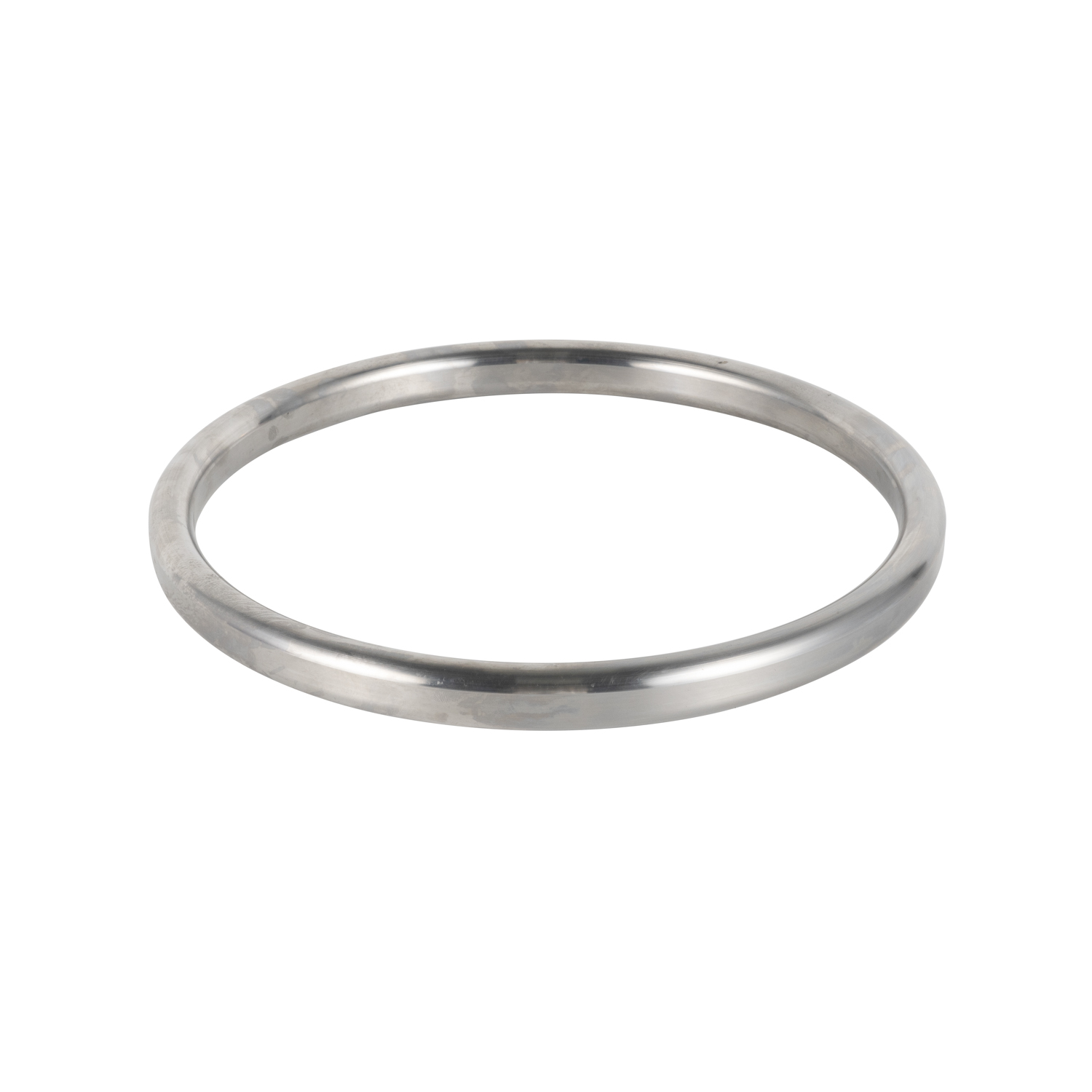
RTJ gasket profile compatibility is essential for reliable metal-to-metal sealing. Gasket dimensions and flange groove geometry must meet applicable ASME B16.20 or API specifications. Incorrect profiles can cause uneven seating, leakage, and flange damage. Always verify ring dimensions, groove condition, and profile compatibility before installation.
RTJ gasket hardness should be lower than the mating flange hardness to allow the ring to deform without damaging the groove. Material hardness requirements depend on the gasket alloy and applicable standards. Verify hardness certifications before installation to maintain sealing integrity and protect flange surfaces.
Material |
Maximum Hardness (HB) |
|---|---|
Soft Iron |
90 |
Low Carbon Steel |
120 |
316 Stainless Steel |
160 |
Inconel 625 |
216 |
Reference values from the supplied material. Confirm allowable hardness against the applicable standard and material specification.
Pressure and temperature ratings directly influence RTJ gasket selection. High-pressure systems require suitable gasket profiles and materials capable of maintaining sealing integrity under thermal cycling. Engineers should verify flange pressure classes, operating temperatures, and material performance against applicable pressure-temperature rating standards.
Chemical compatibility ensures RTJ gaskets resist corrosion, cracking, and material degradation. Sour service applications may require compliance with NACE MR0175/ISO 15156, while chloride exposure and aggressive chemicals demand suitable corrosion-resistant alloys. Verify process media, operating conditions, and material certifications before selection.
Style R RTJ gaskets are available in oval and octagonal profiles. Oval rings are commonly used with older round-bottom grooves, while octagonal rings are suited to compatible flat-bottom grooves. Both provide metal-to-metal sealing, but the selected profile must match the flange groove geometry and applicable standards.
Style RX RTJ gaskets feature a pressure-energized design that increases sealing contact as internal pressure rises. They are commonly used in compatible API 6B flange applications, particularly in oil and gas equipment. Proper groove compatibility, gasket dimensions, and flange assembly are essential for reliable performance.

Style BX RTJ gaskets are designed for high-pressure applications using compatible API 6BX flanges. Their pressure-balanced design supports reliable sealing under demanding operating conditions. BX rings are not interchangeable with R or RX profiles and require precise flange alignment and installation.
Specialty RTJ gaskets address non-standard flange configurations, transition connections, and specific testing requirements. Custom-engineered profiles must be verified for dimensional compatibility, material properties, and operating pressure. Temporary test gaskets should not be used for permanent service unless specifically approved for that application.
Gasket Profile |
Groove Compatibility |
Pressure Energized |
Primary Application |
|---|---|---|---|
Style R (Oval) |
Round & Flat Bottom |
No |
Legacy ASME B16.5 systems |
Style R (Octagonal) |
Flat Bottom Only |
No |
Modern Class 900+ ASME flanges |
Style RX |
Style R Flat Bottom |
Yes |
API 6B with shock/vibration |
Style BX |
API 6BX Only |
Yes |
Extreme pressure up to 20,000 psi |
Soft iron and low carbon steel RTJ gaskets provide cost-effective sealing for non-corrosive applications, including utility pipelines and suitable hydrocarbon services. Their relatively low hardness supports effective metal-to-metal sealing, but they are vulnerable to rust and chemical corrosion. Proper storage, surface inspection, and material compatibility checks are essential for reliable performance.
Stainless steel RTJ gaskets, including 304, 316, and 347 grades, offer improved corrosion resistance and durability. Grade 316 is suitable for many chemical processing environments, while 347 provides enhanced resistance to sensitization during elevated-temperature exposure. Proper material selection and hardness verification help prevent flange groove damage and maintain sealing reliability.
High-nickel alloy RTJ gaskets provide corrosion resistance and mechanical performance in demanding environments. Inconel is commonly selected for high-temperature applications, while Monel and Hastelloy grades suit specific aggressive chemical conditions. Engineers should verify chemical compatibility, applicable NACE requirements, material certifications, and traceability before installation.
Protective coatings such as zinc, cadmium, and PTFE can help reduce surface corrosion and installation friction on compatible metallic gaskets. Coating selection must consider chemical exposure, operating temperature, dimensional tolerances, and environmental regulations. Proper coating thickness and material compatibility are essential to maintain sealing performance.
Proper RTJ gasket handling and storage help prevent scratches, deformation, and corrosion that could compromise sealing. Store gaskets in protective packaging, use suitable transport containers, and inspect sealing surfaces before installation. Verify material grade, dimensions, hardness, and visible surface condition to ensure compatibility with the specified flange.
Flange groove surface finish directly affects RTJ gasket sealing performance. Grooves must be clean, accurately machined, and free from scratches, corrosion, or deformation. Inspect surface roughness and groove dimensions against applicable standards and manufacturer specifications. Damaged sealing surfaces should be properly repaired before gasket installation.
RTJ gaskets should not be reused after removal because initial installation causes permanent plastic deformation of the sealing surfaces. Reinstalling a previously compressed gasket can compromise sealing reliability and increase leakage risks. Always use a new, correctly specified gasket when reassembling critical high-pressure flange connections.
Proper bolt loading ensures uniform RTJ gasket seating and reliable metal-to-metal sealing. Use calibrated torque equipment, approved thread lubrication, and a progressive cross-pattern tightening sequence. Apply bolt loads according to the applicable flange and gasket specifications while checking flange alignment to prevent uneven compression and groove damage.
Proper specification is an exact science dictated by flange standards, pressure class, and metallurgical compatibility. There is no room for approximation in HPHT environments. Standardize your selection by first identifying the flange groove and pressure class. Next, match the metallurgy to the process media. Finally, ensure the hardness differential protects the flange asset.
To secure your piping systems, implement these next steps:
Audit current piping specifications against ASME B16.20 dimensional standards to ensure geometric compliance.
Inspect your maintenance inventory to verify proper material test reports (MTRs) and hardness ratings.
Enforce strict single-use policies for all metallic rings across your facilities to prevent catastrophic re-use failures.
Calibrate all torque wrenches and hydraulic tensioning equipment used for flange assembly on a regular schedule.
A: No. RTJ gaskets rely on plastic deformation—yielding the softer gasket material into the harder flange groove—to create a seal. Once compressed, the gasket permanently loses its original profile and work-hardens, making it incapable of sealing again.
A: Oval gaskets have a rounded profile designed for older, round-bottom flange grooves. Octagonal gaskets have a flat-angled profile that provides better sealing efficiency in modern flat-bottom grooves. Octagonal gaskets can be used in flat-bottom grooves, but oval gaskets are required for round-bottom grooves.
A: The gasket must be softer (typically by 15-20 Brinell hardness points) so that it deforms into the micro-imperfections of the flange groove when bolt load is applied. If the gasket is harder than the flange, it will permanently damage the expensive flange groove.
A: Yes, Style RX gaskets are designed to fit into standard Style R flat-bottom grooves. They offer the added benefit of a pressure-energized design, which increases sealing efficiency as internal system pressure rises.
A: According to ASME B16.20 standards, the maximum hardness for a soft iron RTJ gasket is typically 90 Brinell (HB). This ensures it remains soft enough to coin into standard carbon steel flanges without causing damage.


